A primer on mechanistic inference with differentiable process-based models in Julia
This tutorial covers techniques for inferring parameters of differentiable process-based models from observational data. These methods are fundamental to mechanistic inference, where we want to explain patterns in a system by understanding the processes that generate them, in contrast to purely statistical or empirical inference, which might identify patterns or correlations in data without necessarily understanding the causes. We’ll mostly focus on differential equation models. Make sure that you stick to the end, where we’ll see how we can not only infer parameter values but also the functional form of processes within the model, by parametrizing the relevant components with neural networks.
Preliminaries
Differentiable Models: Definition and Properties
One can usually write a model as a map ℳ mapping some parameters p, an initial state u0 and a time t to a future state ut
ut = ℳ(u0, t, p).
A model ℳ is differentiable if we can compute its partial derivatives with respect to parameters p or initial conditions u0. The derivative $\frac{\partial \mathcal{M}}{\partial \theta}$ quantifies the sensitivity of model outputs to infinitesimal perturbations in parameter θ.
Recall your Calculus class!
$$\frac{df}{dx}(x) = \lim_{h \to 0} \frac{f(x + h) - f(x)}{h}$$
Let’s illustrate this concept with the logistic equation model. This model has an analytic formulation given by:
$$\mathcal{M}(u_0, p, t) = \frac{K}{1 + \big( \frac{K-u_0}{u_0} \big) e^{rt}}$$
Let’s code it
using UnPack
using Plots
using Random
using ComponentArrays
using BenchmarkTools
Random.seed!(0)

function mymodel(u0, p, t)
    T = eltype(u0)
    @unpack r, K = p

    @. K / (one(T) + (K - u0) / u0 * exp(-r * t))
end

p = ComponentArray(;r = 1., K = 1.)
u0 = 0.005

tsteps = range(0, 20, length=100)
y = mymodel(u0, p, tsteps)

plot(tsteps, y)

What is a
ComponentArray?A
ComponentArrayis a convenient Array type that allows to access array elements with symbols, similarly to aNamedTuple, while behaving like a standard array. For instance, you could do something likecv = ComponentVector(;a = 1, b = 2) cv .= [3, 4]ComponentVector{Int64}(a = 3, b = 4)This is useful, because you can only calculate a gradient w.r.t a
Vector!
Now let’s try to calculate the gradient of this model. While you could in this case derive the gradient analytically, an analytic derivation is generally tricky with complex models. And what about models that can only be simulated numerically, with no analytic expressions? We need to find a more automatized way to calculate gradients.
How about the finite difference method?
Exercise: finite differences
Implement the function
∂mymodel_∂K(h, u0, p, t)which returns the model’s derivative with respect toK, calculated with a smallhto be provided by the user.
Solution
function ∂mymodel_∂K(h, u0, p, t)
    phat = (; r = p.r, K= p.K + h)
    return (mymodel(u0, phat, t) - mymodel(u0, p, t)) / h
end
∂mymodel_∂K(1e-1, u0, p, 1.)
0.00010443404854589694
The gradient of the model is useful to understand how a parameter
influences the output of the model. Let’s calculate the importance of
the carrying capacity K on the model output:
dm_dp = ∂mymodel_∂K(1e-1, u0, p, tsteps)
plot(tsteps, dm_dp)
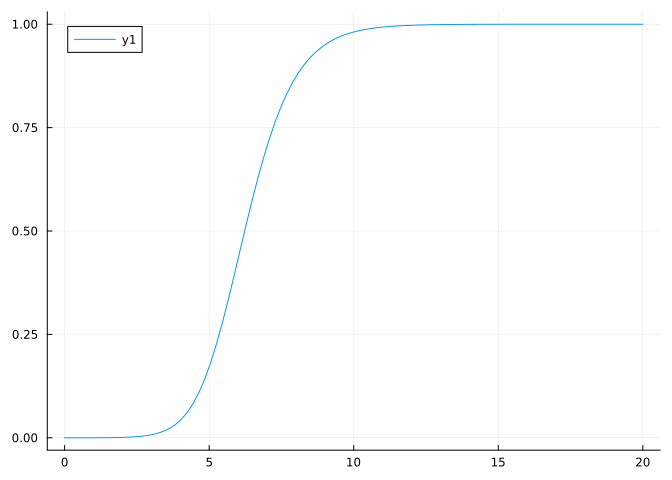
As you can observe, the carrying capacity has no effect at small t where population is small, and its influence on the dynamics grows as the population grows. We expect the reverse effect for r.
The Role of Gradients in Statistical Inference
The ability to calculate the derivative of a model is crucial when it comes to inference. Both within a full Bayesian inference context, where one wants to sample the posterior distribution of parameters θ given data u, p(θ|u), or when one wants to obtain a point estimate $\theta^\star = \text{argmax}_\theta (p(\theta | u))$ (frequentist or machine learning context), the model gradient proves very useful. In a full Bayesian inference context, they are used e.g. with Hamiltonian Markov Chains methods, such as the NUTS sampler, and in a machine learning context, they are used with gradient-based optimizer.
Gradient Descent Optimization
Gradient descent provides a fundamental algorithm for parameter estimation. The following figure illustrates the algorithm for the scalar parameter case.
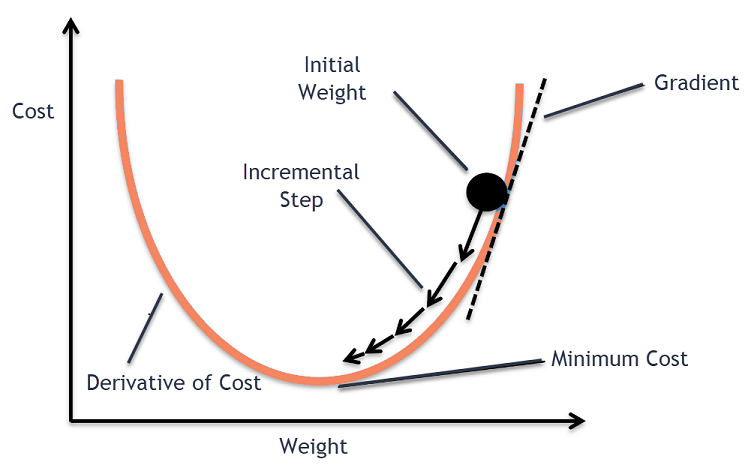
Starting from an initial parameter estimate p0, the algorithm iteratively updates parameters using the gradient $\frac{d \mathcal{M}}{dp}$ according to:
$$p_{n+1} = p_n - \eta \frac{d \mathcal{M}}{dp}(u_0, t, p) $$
where η denotes the learning rate (step size). Gradient-based optimization methods exhibit favorable scaling properties in high-dimensional parameter spaces, often achieving computational complexity advantages over derivative-free alternatives.
Automatic differentiation
Let’s go back to our method ∂mymodel_∂p. What is the optimal value of
h to calculate the derivative? This is a tricky question, because a
too small h can lead to round off errors (see more explanations
here)
while h too large also leads to a bad approximation of the asymptotic
definition.
Fortunately, a bunch of techniques referred to as automatic differentiation (AD) allows to exactly differentiate any piece of numerical functions. In practice, your code must be exclusively written within an AD-backend, such as Torch, JAX or Tensorflow. Those libraries do not know how to differentiate code not written in their own language, such as normal Python code.
Fortunately, Julia is an AD-pervasive language! This means that any piece of Julia code is theoretically differentiable with AD.
using ForwardDiff

@btime ForwardDiff.gradient(p -> mymodel(u0, p, 1.), p);
1.225 μs (12 allocations: 432 bytes)
This property makes Julia particularly well-suited for model calibration and inference: models written in native Julia are automatically compatible with AD-based inference frameworks.
For comprehensive coverage of AD in Julia, consult this tutorial and technical presentation.
Now let’s get started with inference.
Mechanistic inference
The Mechanistic Model and Synthetic Data Generation
We’ll use a simple dynamical community model, the Lotka Volterra model, to generate data. We’ll then contaminate this data with noise, and try to recover the parameters that have generated the data. The goal of the session will be to estimate those parameters from the data, using a bunch of different techniques.
So let’s first generate the data.
using OrdinaryDiffEq

# Define Lotka-Volterra model.
function lotka_volterra(du, u, p, t)
    # Model parameters.
    @unpack α, β, γ, δ = p
    # Current state.
    x, y = u

    # Evaluate differential equations.
    du[1] = (α - β * y) * x # prey
    du[2] = (δ * x - γ) * y # predator

    return nothing
end

# Define initial-value problem.
u0 = [2.0, 2.0]
p_true = (;α = 1.5, β = 1.0, γ = 3.0, δ = 1.0)
# tspan = (hudson_bay_data[1,:t], hudson_bay_data[end,:t])
tspan = (0., 5.)
tsteps = range(tspan[1], tspan[end], 51)
alg = Tsit5()

prob = ODEProblem(lotka_volterra, u0, tspan, p_true)

saveat = tsteps
sol_true = solve(prob, alg; saveat)
# Plot simulation.
plot(sol_true)
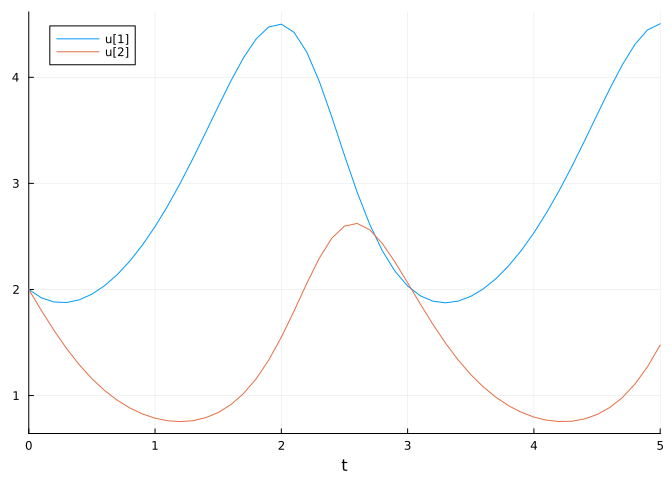
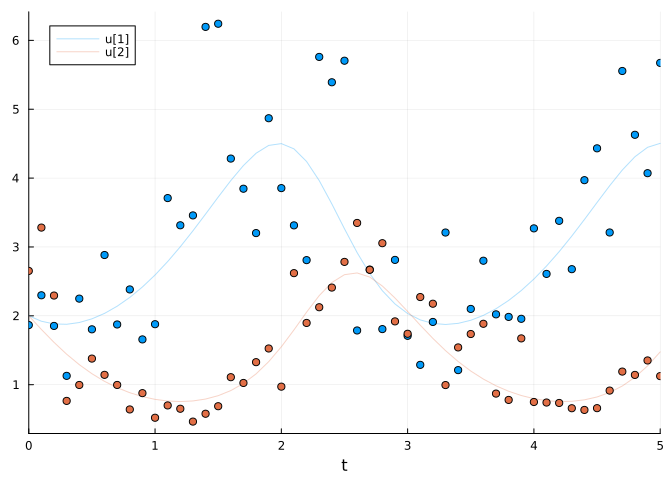
This is the true state of the system. Now let’s contaminate it with observational noise.
Exercise: Introducing observational noise
Create a
data_matarray consisting of the ODE solution perturbed by lognormally-distributed multiplicative noise with standard deviation0.3.Note
We employ lognormal rather than Gaussian noise to ensure observations remain strictly positive, consistent with the physical constraint that population abundances cannot be negative.
Solution
data_mat = Array(sol_true) .* exp.(0.3 * randn(size(sol_true)))
# Plot simulation and noisy observations.
plot(sol_true; alpha=0.3)
scatter!(sol_true.t, data_mat'; color=[1 2], label="")
Now that we have our data, let’s do some inference!
Mechanistic Inference via Optimization
We’ll get started with a very crude approach to inference, where we’ll treat the calibration of our LV model similarly to a supervised machine learning task. To do so, we’ll write a loss function, defining a distance between our model and the data, and we’ll try to minimize this loss. The parameter minimizing this loss will be our best model parameter estimate.
function loss(p)
    predicted = solve(prob,
                        alg;
                        p,
                        saveat,
                        abstol=1e-6,
                        reltol = 1e-6)

    l = 0.
    for i in 1:length(predicted)
        if all(predicted[i] .> 0)
            l += sum(abs2, log.(data_mat[:, i]) - log.(predicted[i]))
        end
    end
    return l, predicted
end
loss (generic function with 1 method)
Note
We explicitly verify that predictions remain positive, as the logarithm is undefined for non-positive values and would otherwise cause numerical errors.
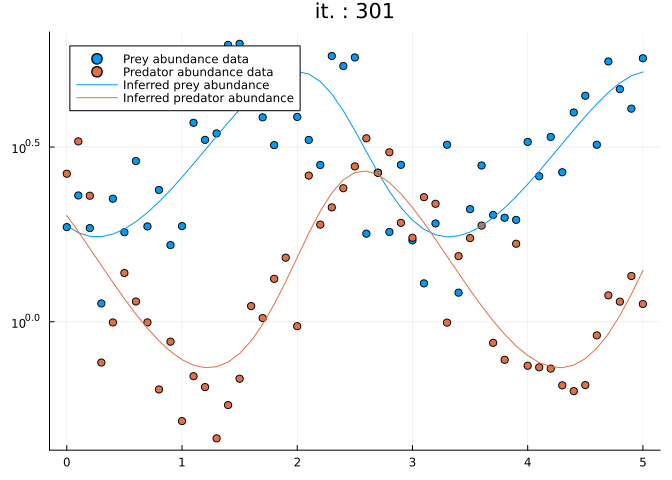
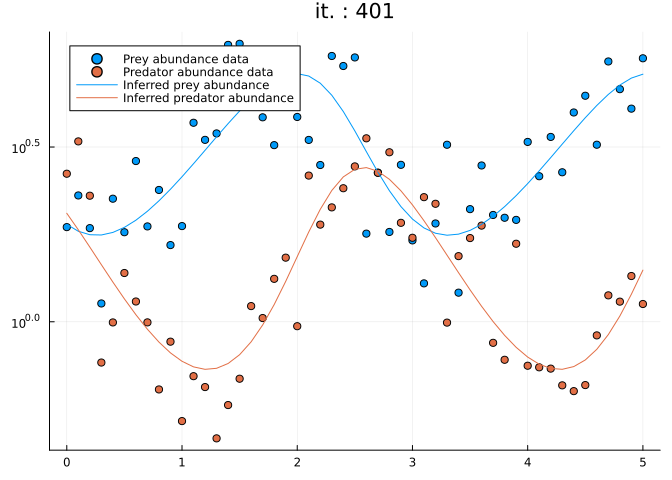
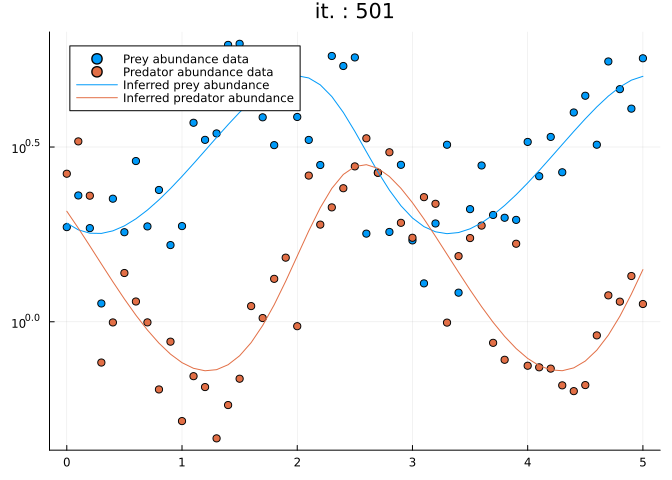
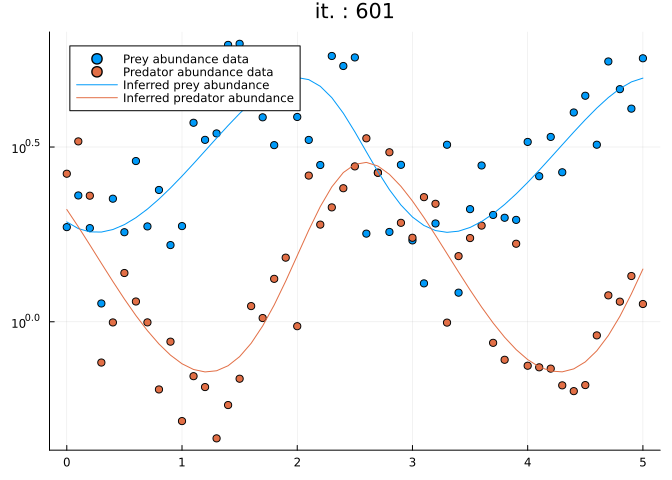
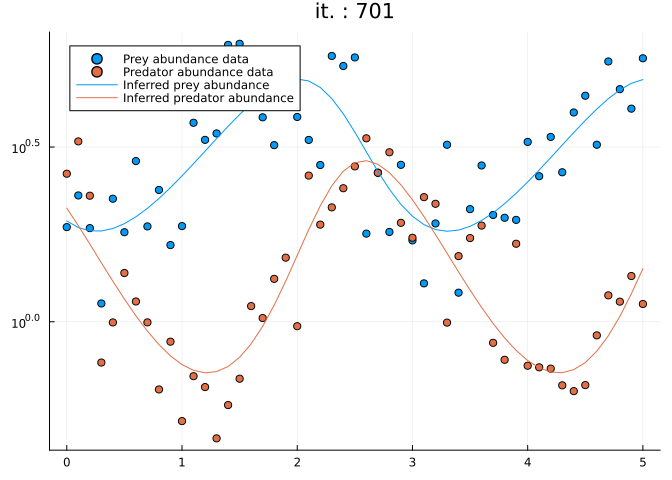
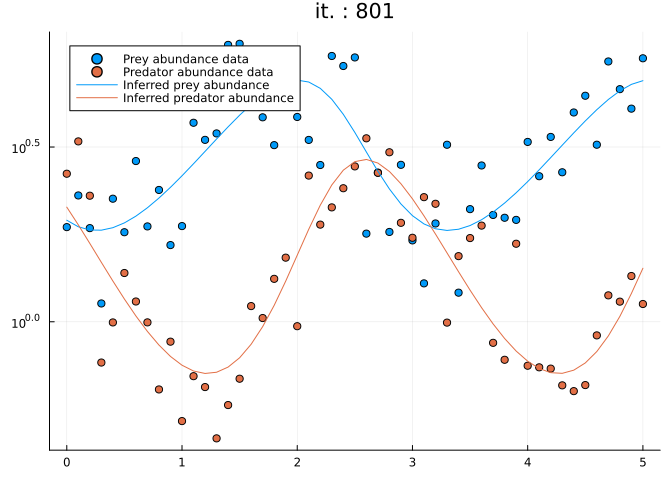
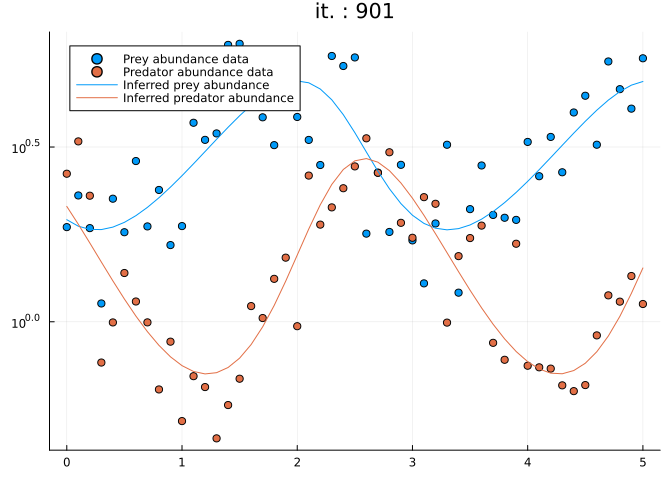
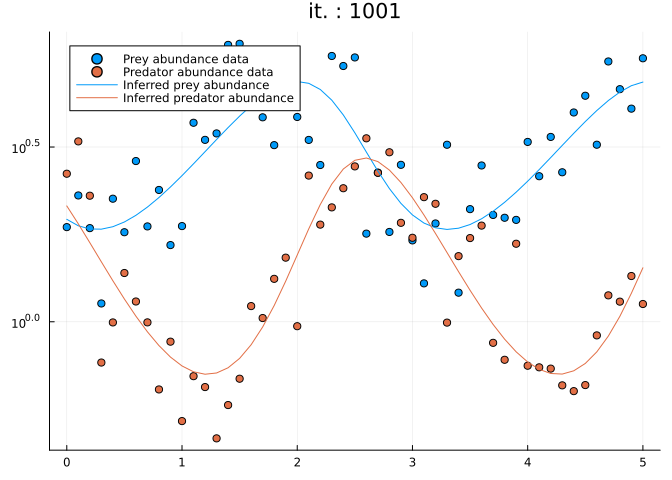
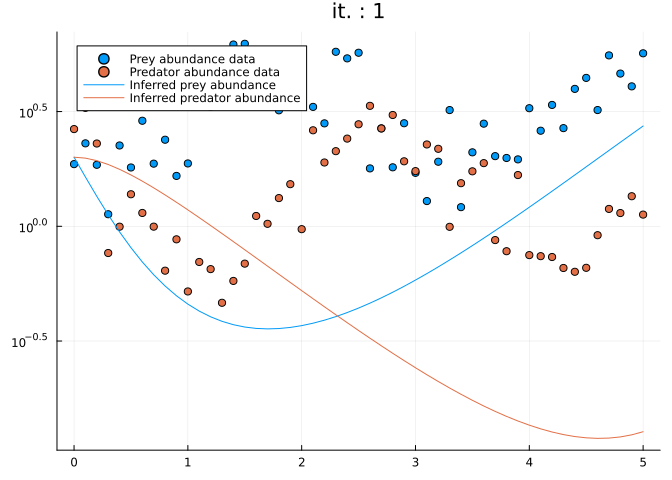
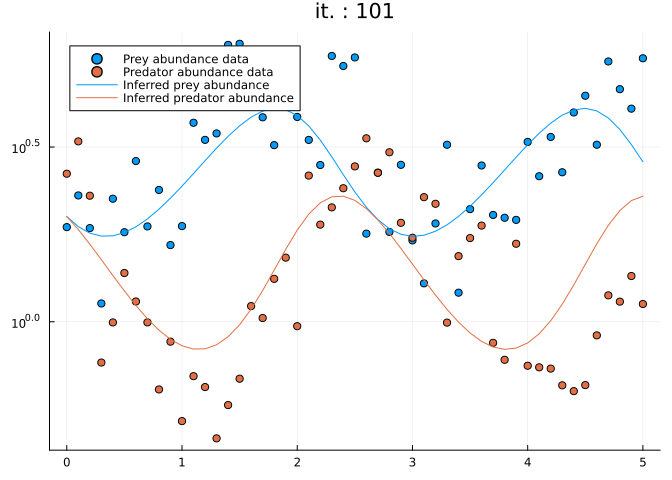
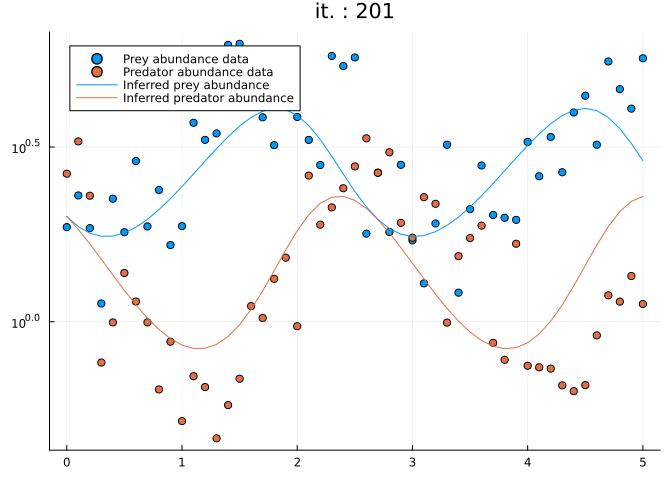
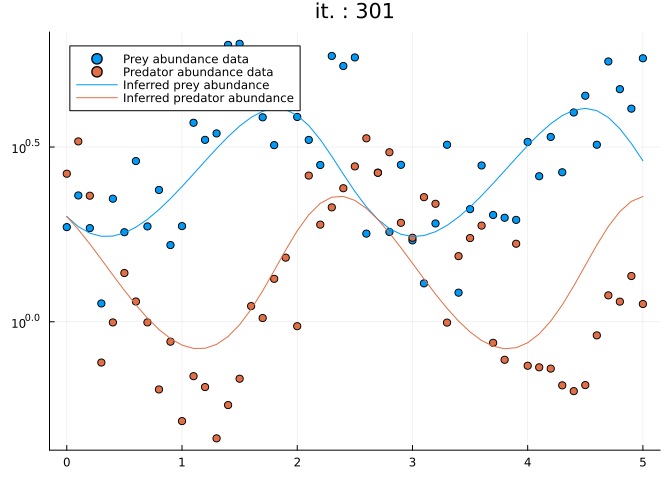
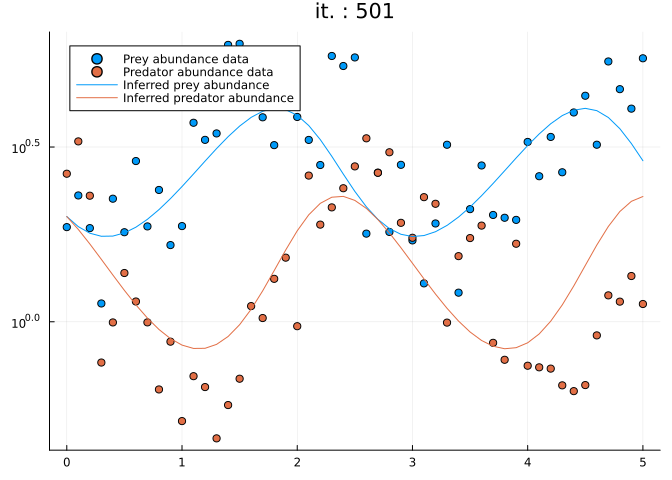
Let’s define a helper function, that will plot how good does the model perform across different iterations.
losses = []
callback = function (p, l, pred; doplot=true)
    push!(losses, l)
    if length(losses)%100==1
        println("Current loss after $(length(losses)) iterations: $(losses[end])")
        if doplot
            plt = scatter(tsteps, data_mat',  color = [1 2], label=["Prey abundance data" "Predator abundance data"])
            plot!(plt, tsteps, pred', color = [1 2], label=["Inferred prey abundance" "Inferred predator abundance"])
            display(plot(plt, yaxis = :log10, title="it. : $(length(losses))"))
        end
    end
    return false
end
#13 (generic function with 1 method)
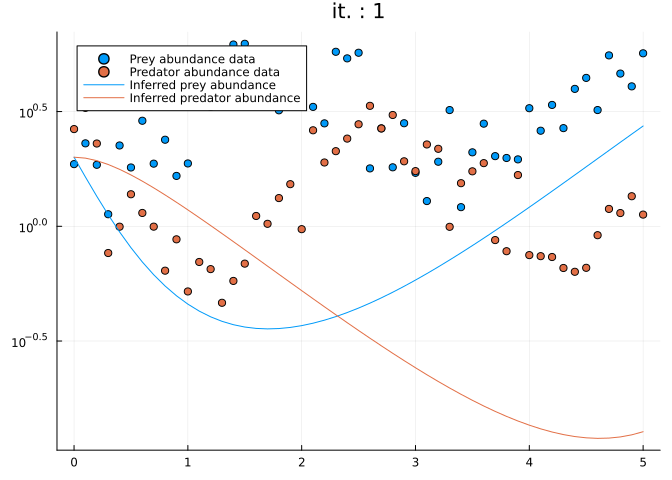
And let’s define a wrong initial guess for the parameters
pinit = ComponentArray(;α = 1., β = 1.5, γ = 1.0, δ = 0.5)

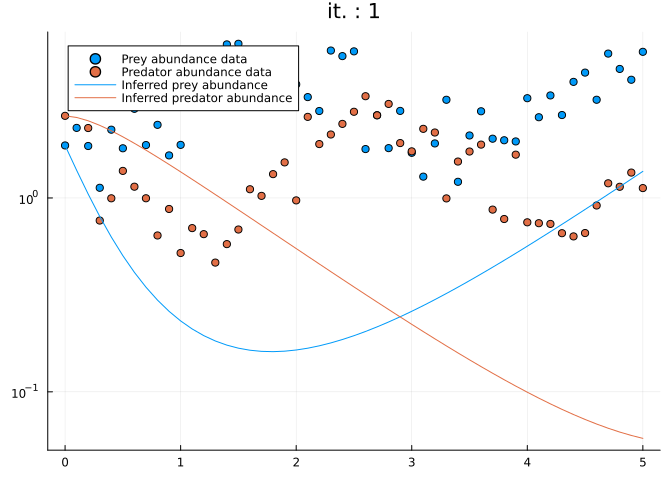
callback(pinit, loss(pinit)...; doplot = true)
Current loss after 1 iterations: 251.10349846646116
false
Our initial predictions are bad, but you’ll likely get even worse predictions in a real-case scenario!
We’ll use the library Optimization, which is a wrapper library around
many optimization libraries in Julia. Optimization therefore provides
us with many different types of optimizers to find parameters minimizing
loss. We’ll specifically use the widely-adopted Adam optimizer,
a stochastic gradient descent variant with adaptive learning rates.
using Optimization
using OptimizationOptimisers
using SciMLSensitivity

adtype = Optimization.AutoZygote()
optf = Optimization.OptimizationFunction((x, p) -> loss(x), adtype)
optprob = Optimization.OptimizationProblem(optf, pinit)

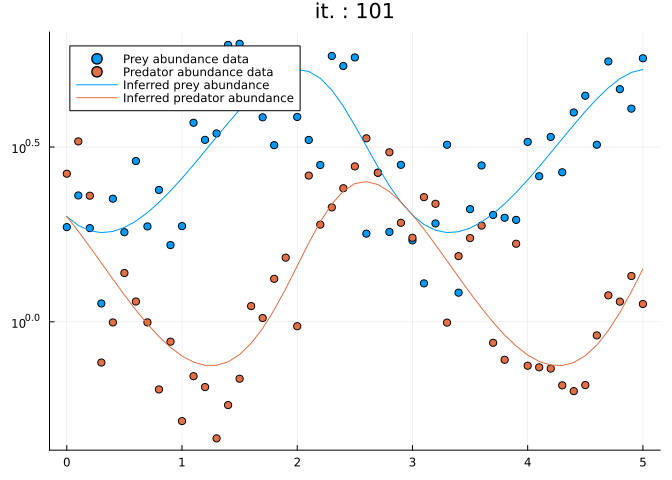
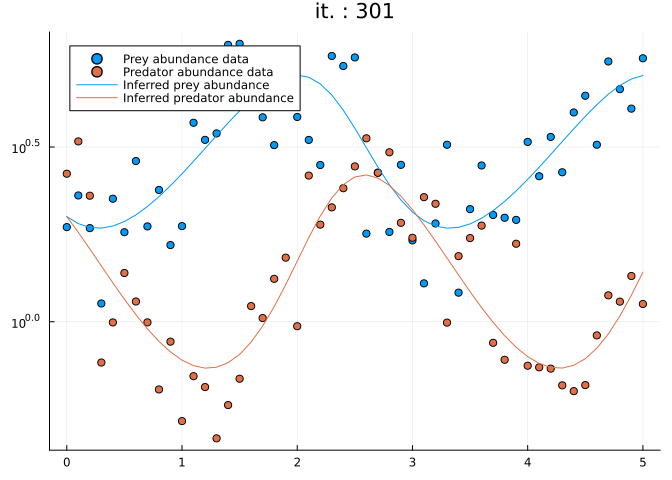
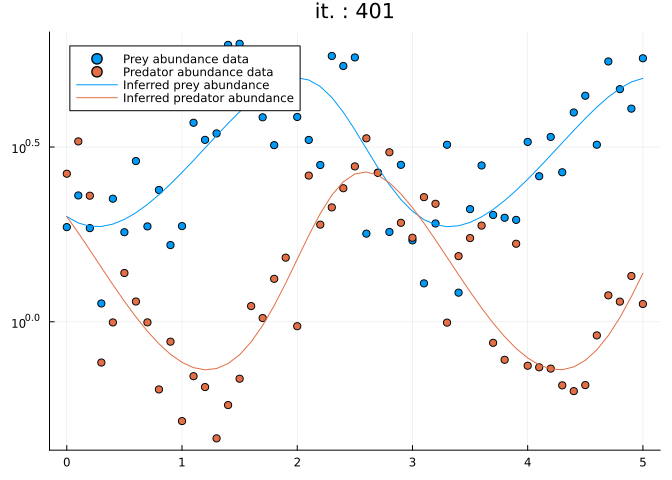
@time res_ada = Optimization.solve(optprob, Adam(0.1); callback, maxiters = 500)
res_ada.minimizer
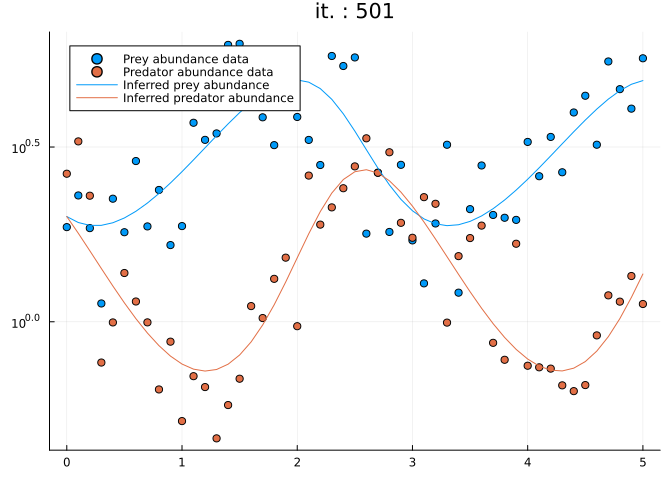
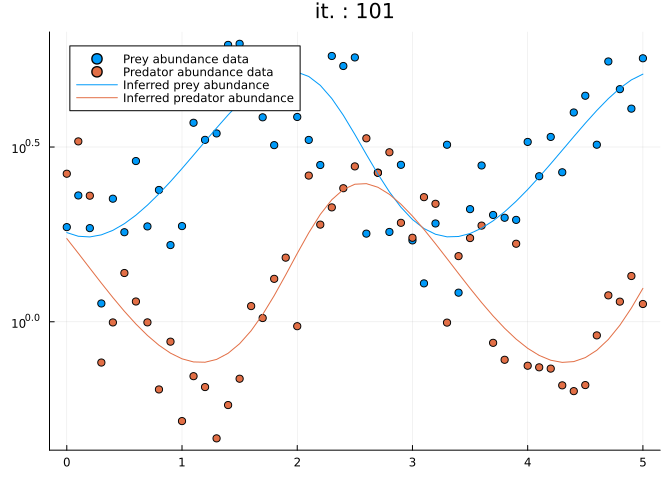
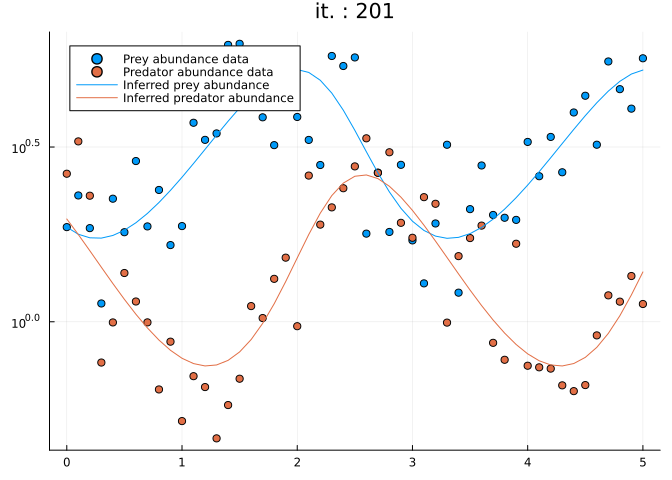
Current loss after 101 iterations: 8.039887486778179
Current loss after 201 iterations: 7.9094080306025445

Current loss after 301 iterations: 7.806219868794404
Current loss after 401 iterations: 7.74345616951535
Current loss after 501 iterations: 7.712910946192632
 13.731183 seconds (49.62 M allocations: 3.145 GiB, 7.17% gc time, 93.45% compilation time: 8% of which was recompilation)

ComponentVector{Float64}(α = 1.5322556800023097, β = 1.0159023620691514, γ = 2.8926590524331766, δ = 0.9148575218436299)
The optimizer successfully converges to reasonable parameter estimates, demonstrating effective model calibration.
Exercise: Joint inference of initial conditions
The current implementation assumes knowledge of the true initial state
u0, an unrealistic assumption in practical applications. In genuine inverse problems, initial conditions must also be inferred from data.Modify the inference framework to simultaneously estimate both parameters and initial conditions.
Solution
function loss2(p)
    predicted = solve(prob,
                        alg;
                        p,
                        u0 = p.u0,
                        saveat,
                        abstol=1e-6,
                        reltol = 1e-6)
    l = 0.
    for i in 1:length(predicted)
        if all(predicted[i] .> 0)
            l += sum(abs2, log.(data_mat[:, i]) - log.(predicted[i]))
        end
    end
    return l, predicted
end
losses = []
pinit = ComponentArray(;α = 1., β = 1.5, γ = 1.0, δ = 0.5, u0 = data_mat[:,1])
adtype = Optimization.AutoZygote()
optf = Optimization.OptimizationFunction((x, p) -> loss2(x), adtype)
optprob = Optimization.OptimizationProblem(optf, pinit)
@time res_ada = Optimization.solve(optprob, Adam(0.1); callback, maxiters = 1000)
res_ada.minimizer
Current loss after 1 iterations: 416.2139476098838
Regularization Techniques
In supervised learning, it is common practice to regularize the model to prevent overfitting. Regularization can also help the model to converge. Regularization is done by adding a penalty term to the loss function:
Loss(θ) = Lossdata(θ) + λ Reg(θ)
Exercise: Implementing regularization
Incorporate a regularization term that penalizes solutions with negative initial conditions, enforcing the physical constraint of non-negative population abundances.
Multiple Shooting Methods
Multiple shooting is a numerical technique that can significantly improve optimization convergence for dynamical systems. Rather than integrating the entire trajectory from a single initial condition (single shooting), multiple shooting partitions the time domain and integrates shorter sub-intervals with independent initial conditions.
Exercise: Implementing multiple shooting
Reformulate the loss function to employ multiple shooting by dividing the observation interval into shorter segments.
Solution
function multiple_shooting_idx(N, length_interval = 10)
    K = N ÷ length_interval
    @assert N % K == 1 "`N - 1` is not a multiple of `length_interval`"
    interval_idxs = [k*length_interval+1:(k+1)*length_interval+1 for k in 0:(K-1)]
    return interval_idxs
end
function loss_multiple_shooting(p)
    interval_idxs = multiple_shooting_idx(length(tsteps))
    l = 0.
    for idx in interval_idxs
        saveat = tsteps[idx]
        # u0_i = sol_true.u[idx[1]] # here we are cheating, using true states for initial conditions!
        u0_i = data_mat[:, idx[1]] # this is not cheating, but it does not work very well
        predicted = solve(prob,
                        alg;
                        u0 = u0_i,
                        p,
                        saveat,
                        tspan=(saveat[1], saveat[end]),
                        abstol=1e-6,
                        reltol = 1e-6)
        for i in 1:length(predicted)
            if all(predicted[i] .> 0)
                l += sum(abs2, log.(data_mat[:, idx[i]]) - log.(predicted[i]))
            end
        end
    end
    predicted = solve(prob,
                    alg;
                    p,
                    saveat=tsteps,
                    abstol=1e-6,
                    reltol = 1e-6)
    return l, predicted
end
losses = []
pinit = ComponentArray(;α = 1., β = 1.5, γ = 1.0, δ = 0.5)
adtype = Optimization.AutoZygote()
optf = Optimization.OptimizationFunction((x, p) -> loss_multiple_shooting(x), adtype)
optprob = Optimization.OptimizationProblem(optf, pinit)
@time res_ada = Optimization.solve(optprob, Adam(0.1); callback, maxiters = 500)
res_ada.minimizer
Current loss after 1 iterations: 57.64884717929634

Sensitivity Analysis Methods
The SciMLSensitivity package and adtype = Optimization.AutoZygote()
specification merit explanation, as they determine how gradients are
computed for ODE-constrained optimization problems.
Automatic differentiation encompasses two primary paradigms: forward-mode and reverse-mode (adjoint) methods, with numerous algorithmic variants for each.
You can specify which ones Optimization.jl will use to differentiate
loss with adtype, see available options
here.
But when it comes to differentiating the solve function from
OrdinaryDiffEq, you want to use AutoZygote(), because when trying to
differentiate solve, a specific adjoint rule provided by the
SciMLSensitivity package will be used.
What are adjoint rules?
Adjoint rules (also called custom derivatives or custom vjps) are algorithmic prescriptions that specify to an AD framework the optimal procedure for computing derivatives of specific functions. For technical details, consult the ChainRules.jl documentation.
Sensitivity algorithms are specified via the sensealg keyword
argument to solve. Multiple specialized algorithms exist (reviewed in
Ma et al. 2024). When sensealg is
omitted, an adaptive polyalgorithm automatically selects an appropriate
method based on problem characteristics.
Consult the documentation for guidance on algorithm selection.
Exercise: Benchmarking sensitivity algorithms
Compare the computational performance of
ForwardDiffSensitivity()andReverseDiffAdjoint()for the Lotka-Volterra inference problem.
Solution
using Zygote
function loss_sensealg(p, sensealg)
    predicted = solve(prob,
                        alg;
                        sensealg,
                        p,
                        u0 = p.u0,
                        saveat,
                        abstol=1e-6,
                        reltol = 1e-6)
    l = 0.
    for i in 1:length(predicted)
        if all(predicted[i] .> 0)
            l += sum(abs2, log.(data_mat[:, i]) - log.(predicted[i]))
        end
    end
    return l
end
loss_sensealg (generic function with 1 method)
pinit = ComponentArray(;α = 1., β = 1.5, γ = 1.0, δ = 0.5, u0 = data_mat[:,1])
@btime Zygote.gradient(p -> loss_sensealg(p, ForwardDiffSensitivity()), pinit);
1.039 ms (14955 allocations: 896.28 KiB)
@btime Zygote.gradient(p -> loss_sensealg(p, ReverseDiffAdjoint()), pinit);
4.904 ms (104797 allocations: 4.45 MiB)
Forward-mode methods typically exhibit superior performance for problems with few parameters, while reverse-mode (adjoint) methods scale more favorably as parameter dimensionality increases.
Well done! Now, let’s jump into the Bayesian world…
Bayesian Inference Framework
Julia has a very strong library for Bayesian inference: Turing.jl.
Let’s declare our first Turing model!
This is done with the @model macro, which allows the library to
automatically construct the posterior distribution based on the
definition of your model’s random variables.
Frequentist (supervised learning) vs. Bayesian approach
The main difference between a frequentist approach and a Bayesian approach is that the latter considers that parameters are random variables. Hence instead of trying to estimate a single value for the parameters, the Bayesian will try to estimate the posterior (joint) distribution of those parameters.
$$ P(\theta | \mathcal{D}) = \frac{P(\mathcal{D} | \theta) P(\theta)}{P(\mathcal{D})} $$
Random variables are defined with the ~ symbol.
Our first Turing model
using Turing
using LinearAlgebra

@model function fitlv(data, prob)
    # Prior distributions.
    σ ~ InverseGamma(3, 0.5)
    α ~ truncated(Normal(1.5, 0.5); lower=0.5, upper=2.5)
    β ~ truncated(Normal(1.2, 0.5); lower=0, upper=2)
    γ ~ truncated(Normal(3.0, 0.5); lower=1, upper=4)
    δ ~ truncated(Normal(1.0, 0.5); lower=0, upper=2)

    # Simulate Lotka-Volterra model.
    p = (;α, β, γ, δ)
    predicted = solve(prob, alg; p, saveat)

    # Observations.
    for i in 1:length(predicted)
        if all(predicted[i] .> 0)
            data[:, i] ~ MvLogNormal(log.(predicted[i]), σ^2 * I)
        end
    end

    return nothing
end
fitlv (generic function with 2 methods)
We now instantiate the probabilistic model and perform posterior inference via Hamiltonian Monte Carlo sampling.
model = fitlv(data_mat, prob)

# Sample 3 independent chains with forward-mode automatic differentiation (the default).
chain = sample(model, NUTS(), MCMCThreads(), 1000, 3; progress=true)
Chains MCMC chain (1000×17×3 Array{Float64, 3}):

Iterations        = 501:1:1500
Number of chains  = 3
Samples per chain = 1000
Wall duration     = 26.64 seconds
Compute duration  = 25.3 seconds
parameters        = σ, α, β, γ, δ
internals         = lp, n_steps, is_accept, acceptance_rate, log_density, hamiltonian_energy, hamiltonian_energy_error, max_hamiltonian_energy_error, tree_depth, numerical_error, step_size, nom_step_size

Summary Statistics
  parameters      mean       std      mcse    ess_bulk    ess_tail      rhat   ⋯
      Symbol   Float64   Float64   Float64     Float64     Float64   Float64   ⋯

           σ    0.2796    0.0195    0.0005   1721.3574   1789.3390    1.0013   ⋯
           α    1.4928    0.1501    0.0052    841.9730    862.7118    1.0025   ⋯
           β    0.9902    0.1210    0.0040    907.2968    995.0953    1.0008   ⋯
           γ    2.9967    0.2656    0.0090    863.2374    992.8786    1.0045   ⋯
           δ    0.9592    0.1043    0.0034    939.4457   1141.4992    1.0034   ⋯
                                                                1 column omitted

Quantiles
  parameters      2.5%     25.0%     50.0%     75.0%     97.5%
      Symbol   Float64   Float64   Float64   Float64   Float64

           σ    0.2449    0.2656    0.2788    0.2922    0.3212
           α    1.2283    1.3875    1.4784    1.5863    1.8276
           β    0.7748    0.9077    0.9816    1.0661    1.2575
           γ    2.4786    2.8192    2.9973    3.1727    3.5358
           δ    0.7563    0.8869    0.9584    1.0274    1.1650
Threads
How many threads do you have running?
Threads.nthreads()will tell you!
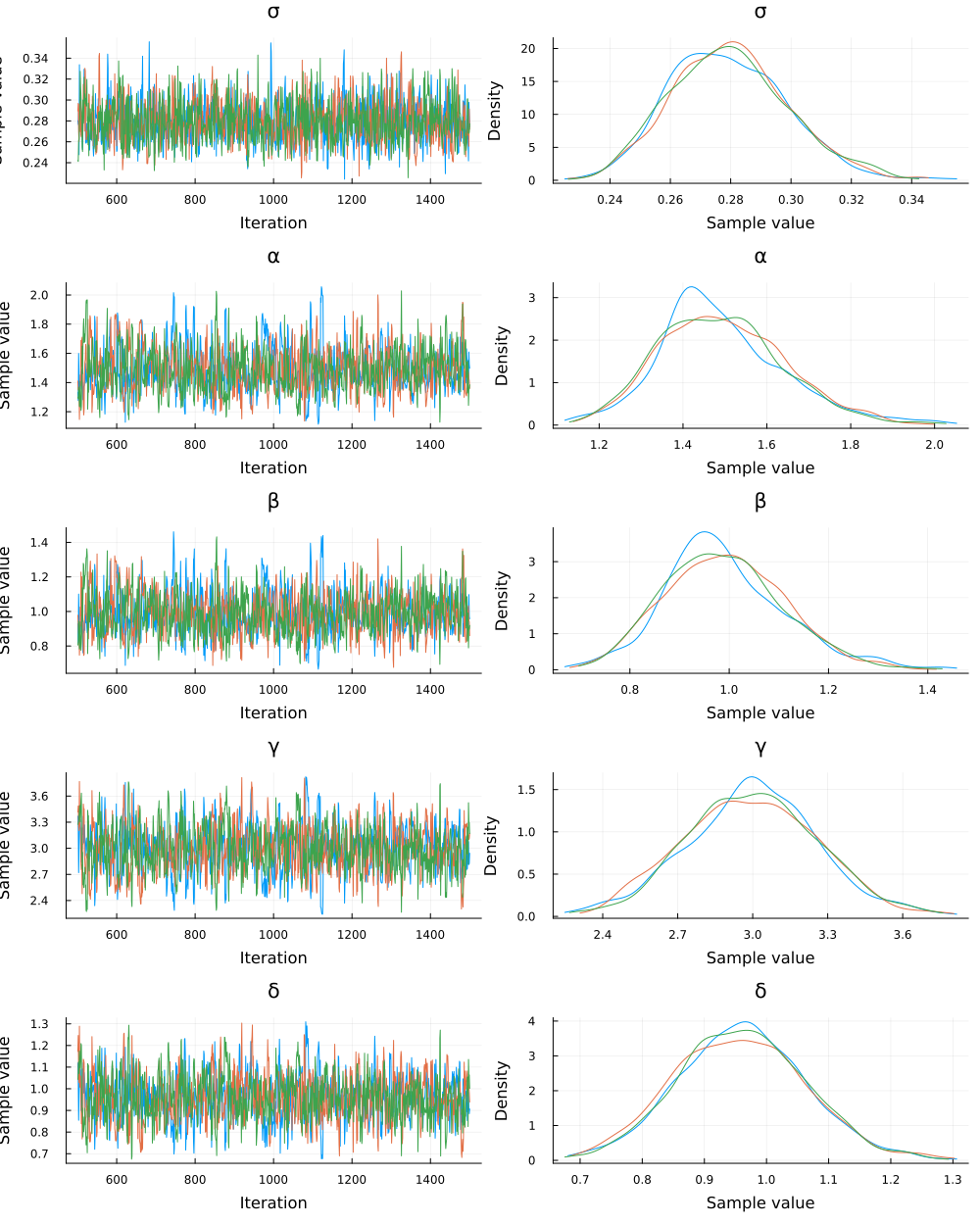
Let’s see if our chains have converged.
using StatsPlots
plot(chain)
Posterior Predictive Checking
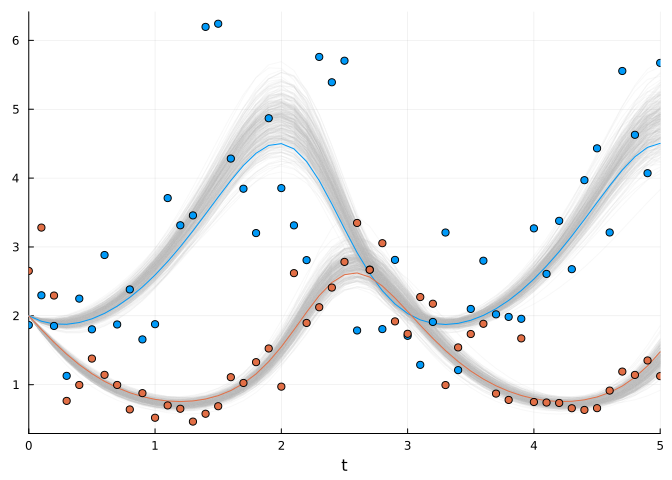
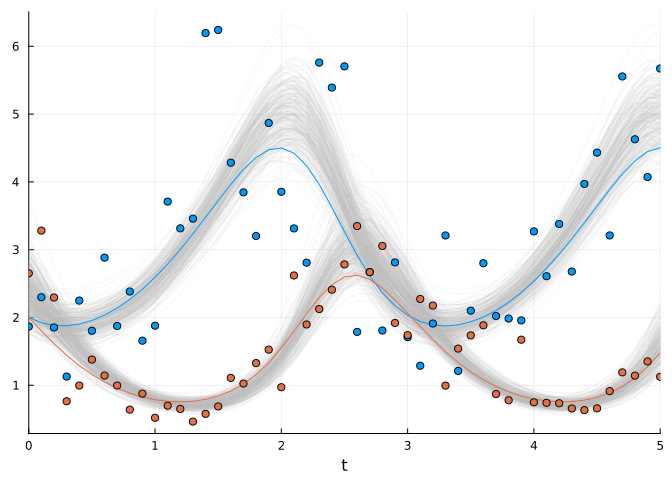
Let’s now generate simulated data using samples from the posterior distribution, and compare to the original data.
function plot_predictions(chain, sol, data_mat)
    myplot = plot(; legend=false)
    posterior_samples = sample(chain[[:α, :β, :γ, :δ]], 300; replace=false)
    for parr in eachrow(Array(posterior_samples))
        p = NamedTuple([:α, :β, :γ, :δ] .=> parr)
        sol_p = solve(prob, Tsit5(); p, saveat)
        plot!(sol_p; alpha=0.1, color="#BBBBBB")
    end

    # Plot simulation and noisy observations.
    plot!(sol; color=[1 2], linewidth=1)
    scatter!(sol.t, data_mat'; color=[1 2])
    return myplot
end
plot_predictions(chain, sol_true, data_mat)
Exercise: Joint inference of initial conditions
The current implementation assumes known initial conditions
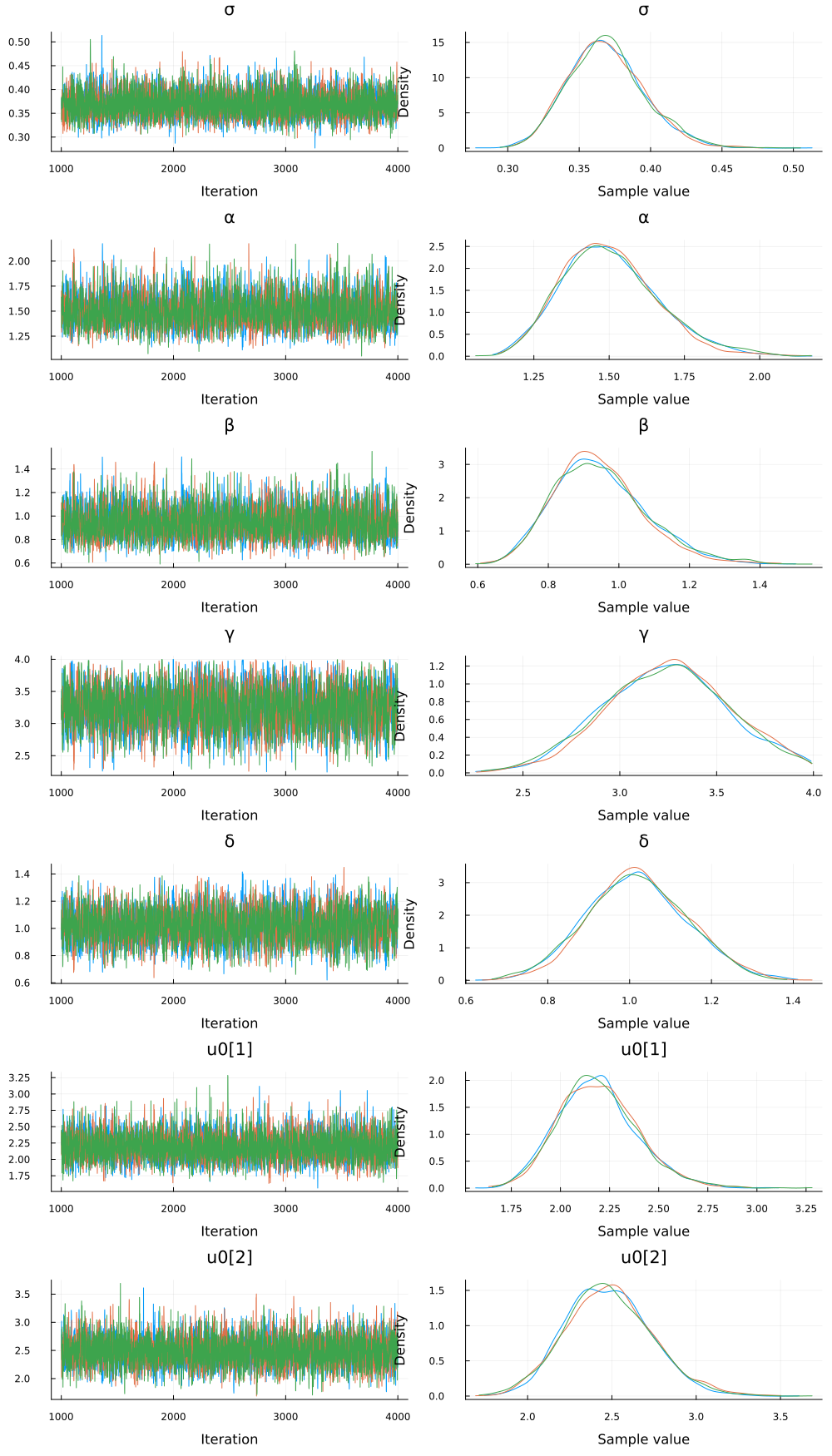
u0. In realistic applications, initial states are typically unknown and must be inferred alongside parameters.Extend the probabilistic model to include prior distributions over initial conditions.
Solution
@model function fitlv2(data, prob)
    # Prior distributions.
    σ ~ InverseGamma(2, 3)
    α ~ truncated(Normal(1.5, 0.5); lower=0.5, upper=2.5)
    β ~ truncated(Normal(1.2, 0.5); lower=0, upper=2)
    γ ~ truncated(Normal(3.0, 0.5); lower=1, upper=4)
    δ ~ truncated(Normal(1.0, 0.5); lower=0, upper=2)
    u0 ~ MvLogNormal(data[:,1], σ^2 * I)
    # Simulate Lotka-Volterra model but save only the second state of the system (predators).
    p = (;α, β, γ, δ)
    predicted = solve(prob, alg; p, u0, saveat)
    # Observations.
    for i in 2:length(predicted)
        if all(predicted[i] .> 0)
            data[:, i] ~ MvLogNormal(log.(predicted[i]), σ^2 * I)
        end
    end
    return nothing
end
model2 = fitlv2(data_mat, prob)
# Sample 3 independent chains.
chain2 = sample(model2, NUTS(), MCMCThreads(), 3000, 3; progress=true)
plot(chain2)
Here is a small utility function to visualize your results.
`plot_predictions2`
function plot_predictions2(chain, sol, data_mat)
    myplot = plot(; legend=false)
    posterior_samples = sample(chain, 300; replace=false)
    for i in 1:length(posterior_samples)
        ps = posterior_samples[i]
        p = get(ps, [:α, :β, :γ, :δ], flatten=true)
        u0 = get(ps, :u0, flatten = true)
        u0 = [u0[1][1], u0[2][1]]

        sol_p = solve(prob, Tsit5(); u0, p, saveat)
        plot!(sol_p; alpha=0.1, color="#BBBBBB")
    end

    # Plot simulation and noisy observations.
    plot!(sol; color=[1 2], linewidth=1)
    scatter!(sol.t, data_mat'; color=[1 2])
    return myplot
end

plot_predictions2(chain2, sol_true, data_mat)
Maximum A Posteriori Estimation
Turing allows you to find the maximum likelihood estimate (MLE) or maximum a posteriori estimate (MAP).
$$ \theta_{MLE} = \underset{\theta}{\text{argmax}} \ P(\mathcal{D} | \theta), \qquad \theta_{MAP} = \underset{\theta}{\text{argmax}} \ P(\theta | \mathcal{D}). $$
MAP and regularization in supervised learning
Although Bayesian inference seems very different from the supervised learning approach we developed in the first part, estimating the MAP, which can be still considered as Bayesian inference, transforms in an optimization problem that can be seen as a supervised task.
To see that, we can log-transform the posterior:
log P(θ|𝒟) = log P(𝒟|θ) + log P(θ) − log P(𝒟)
Since the evidence P(𝒟) is independent of θ, it can be ignored when maximizing with respect to θ. Therefore, the MAP estimate simplifies to:
$$ \theta_{MAP} = \underset{\theta}{\text{argmax}} \ \left[\log P(\mathcal{D} | \theta) + \log P(\theta)\right] $$
Here, log P(𝒟|θ) can be seen as our previous non-regularized
lossand log P(θ) acts as a regularization term, penalizing unlikely parameter values based on our prior beliefs. Priors on parameters can be seen as regularization term.
Turing provides maximum_likelihood and maximum_a_posteriori
functions for point estimation.
Random.seed!(0)
maximum_a_posteriori(model2, maxiters = 1000)
ModeResult with maximized lp of -104.88
[0.3545376205457767, 1.4695692517420373, 0.9162499950736273, 3.263944963496157, 1.0243607922108577, 2.150749205538098, 2.4795481828054595]
Since Turing uses under the hood the same Optimization.jl library, you
can specify which optimizer youd’d like to use.
map_res = maximum_a_posteriori(model2, Adam(0.01), maxiters=2000)
ModeResult with maximized lp of -104.88
[0.35455374965749115, 1.4707686527453756, 0.9171941147556801, 3.2614628620071664, 1.0235193248242322, 2.1506473758409883, 2.4789084651090993]
We verify optimization convergence by examining the result object:
@show map_res.optim_result
map_res.optim_result = retcode: Default
u: [-1.036895323466616, -0.05847935462336067, -0.16599185850450063, 1.1190957778225292, 0.04704732580671333, 0.765768901858866, 0.9078183282523818]
Final objective value:     104.87762402604213

retcode: Default
u: 7-element Vector{Float64}:
 -1.036895323466616
 -0.05847935462336067
 -0.16599185850450063
  1.1190957778225292
  0.04704732580671333
  0.765768901858866
  0.9078183282523818
What’s very nice is that Turing.jl provides you with utility functions to analyse your mode estimation results.
using StatsBase
coeftable(map_res)
| Coef. | Std. Error | z | Pr(> | z | ) | |
|---|---|---|---|---|---|---|
| σ | 0.354554 | 0.0250558 | 14.1506 | 1.85249e-45 | 0.305445 | 0.403662 |
| α | 1.47077 | 0.157711 | 9.32571 | 1.10241e-20 | 1.16166 | 1.77988 |
| β | 0.917194 | 0.125103 | 7.3315 | 2.27594e-13 | 0.671996 | 1.16239 |
| γ | 3.26146 | 0.335101 | 9.73279 | 2.18526e-22 | 2.60468 | 3.91825 |
| δ | 1.02352 | 0.124744 | 8.20497 | 2.30644e-16 | 0.779026 | 1.26801 |
| u0[1] | 2.15065 | 0.18462 | 11.6491 | 2.31953e-31 | 1.7888 | 2.51249 |
| u0[2] | 2.47891 | 0.247352 | 10.0218 | 1.22272e-23 | 1.99411 | 2.96371 |
Exercise: Partially observed state
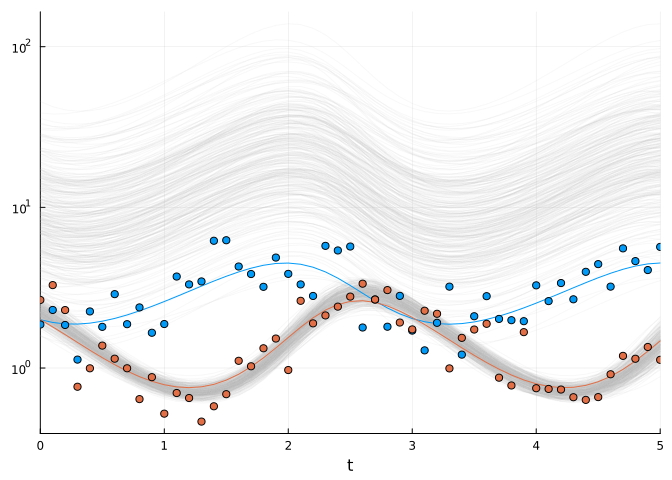
Let’s assume the following situation: for some reason, you only have observation data for the predator. Could you still infer all parameters of your model, including those of the prey?
Could be! Because the signal of the variation in abundance of the predator contains information on the dynamics of the whole predator-prey system.
Do it!
You’ll need to assume so prior state for the prey. Just assume that it is the same as that of the predator.
Solution
@model function fitlv3(data::AbstractVector, prob)
    # Prior distributions.
    σ ~ InverseGamma(2, 3)
    α ~ truncated(Normal(1.5, 0.5); lower=0.5, upper=2.5)
    β ~ truncated(Normal(1.2, 0.5); lower=0, upper=2)
    γ ~ truncated(Normal(3.0, 0.5); lower=1, upper=4)
    δ ~ truncated(Normal(1.0, 0.5); lower=0, upper=2)
    u0 ~ MvLogNormal([data[1], data[1]], σ^2 * I)
    # Simulate Lotka-Volterra model but save only the second state of the system (predators).
    p = (;α, β, γ, δ)
    predicted = solve(prob, Tsit5(); p, u0, saveat, save_idxs=2)
    # Observations of the predators.
    for i in 2:length(predicted)
        if predicted[i] > 0
            data[i] ~ LogNormal(log.(predicted[i]), σ^2)
        end
    end
    return nothing
end
model3 = fitlv3(data_mat[2, :], prob)
# Sample 3 independent chains.
chain3 = sample(model3, NUTS(), MCMCThreads(), 3000, 3; progress=true)
plot(chain3)
p = plot_predictions2(chain3, sol_true, data_mat)
plot!(p, yaxis=:log10)
Now you need to realise that up to now, we had a relatively simple model. How would this model scale, should we have a much larger model? Let’s cook-up some idealised LV model. –>
Automatic Differentiation Backend Selection for MCMC
The NUTS sampler uses automatic differentiation under the hood.
By default, Turing.jl uses ForwardDiff.jl as an AD backend, meaning
that the SciML sensitivity methods are not used when the solve
function is called. However, you could change the AD backend to Zygote
with adtype=AutoZygote().
chain2 = sample(model2, NUTS(), MCMCThreads(), adtype=AutoZygote(), 3000, 3; progress=true)
Chains MCMC chain (3000×19×3 Array{Float64, 3}):

Iterations        = 1001:1:4000
Number of chains  = 3
Samples per chain = 3000
Wall duration     = 57.41 seconds
Compute duration  = 56.94 seconds
parameters        = σ, α, β, γ, δ, u0[1], u0[2]
internals         = lp, n_steps, is_accept, acceptance_rate, log_density, hamiltonian_energy, hamiltonian_energy_error, max_hamiltonian_energy_error, tree_depth, numerical_error, step_size, nom_step_size

Summary Statistics
  parameters      mean       std      mcse    ess_bulk    ess_tail      rhat   ⋯
      Symbol   Float64   Float64   Float64     Float64     Float64   Float64   ⋯

           σ    0.3690    0.0267    0.0003   6634.3954   6080.5757    1.0000   ⋯
           α    1.5026    0.1596    0.0030   2825.0996   3566.4279    1.0004   ⋯
           β    0.9458    0.1303    0.0024   3055.7314   3652.9872    1.0015   ⋯
           γ    3.2448    0.3214    0.0060   2806.7123   2850.3476    1.0009   ⋯
           δ    1.0199    0.1212    0.0022   3167.1794   3679.8852    1.0008   ⋯
       u0[1]    2.1903    0.2017    0.0026   6066.7978   5252.2598    1.0001   ⋯
       u0[2]    2.4814    0.2547    0.0034   5638.9388   5057.7901    1.0007   ⋯
                                                                1 column omitted

Quantiles
  parameters      2.5%     25.0%     50.0%     75.0%     97.5%
      Symbol   Float64   Float64   Float64   Float64   Float64

           σ    0.3219    0.3507    0.3675    0.3854    0.4254
           α    1.2290    1.3890    1.4889    1.6003    1.8558
           β    0.7245    0.8536    0.9332    1.0234    1.2380
           γ    2.6101    3.0243    3.2492    3.4636    3.8759
           δ    0.7863    0.9365    1.0169    1.1007    1.2611
       u0[1]    1.8288    2.0508    2.1789    2.3149    2.6257
       u0[2]    2.0080    2.3053    2.4727    2.6454    3.0176
Doing so, you could specify within solve the adtype. It is usually a
good idea to try a few different sensitivity algorithm.
See here for more information.
Exercise: Sensitivity algorithm performance comparison
Benchmark the computational efficiency of
ForwardDiffSensitivity()versusReverseDiffAdjoint()in the Bayesian inference context.
Variational Inference
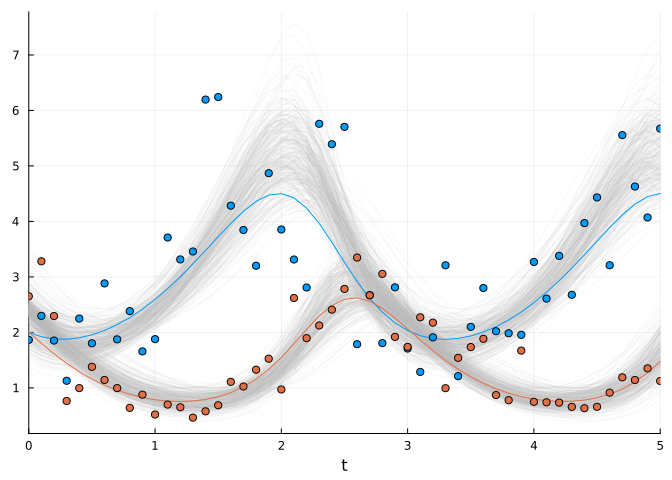
Variational inference (VI) consists in approximating the true posterior distribution P(θ|𝒟) by an approximate distribution Q(θ; ϕ), where ϕ is a parameter vector defining the shape, location, and other characteristics of the approximate distribution Q, to be optimzed so that Q is as close as possible to P. This is achieved by minimizing the Kullback-Leibler (KL) divergence between the true posterior P(θ|𝒟) and the approximate distribution :
$$ \phi^* = \underset{\phi}{\text{argmin}} \ \text{KL}\left(Q(\theta; \phi) \||\ P(\theta | \mathcal{D})\right) $$
The advantage of VI over traditional MCMC sampling methods is that VI is generally faster and more scalable to large datasets, as it transforms the inference problem into an optimization problem.
Let’s do VI in Turing!
import Flux
using Turing: Variational
model = fitlv2(data_mat, prob)
q0 = Variational.meanfield(model)
advi = ADVI(10, 10_000) # first arg is the

q = vi(model, advi, q0; optimizer=Flux.ADAM(1e-2))

function plot_predictions_vi(q, sol, data_mat)
    myplot = plot(; legend=false)
    z = rand(q, 300)
    for parr in eachcol(z)
        p = NamedTuple([:α, :β, :γ, :δ] .=> parr[2:5])
        u0 = parr[6:7]
        sol_p = solve(prob, Tsit5(); u0, p, saveat)
        plot!(sol_p; alpha=0.1, color="#BBBBBB")
    end

    # Plot simulation and noisy observations.
    plot!(sol; color=[1 2], linewidth=1)
    scatter!(sol.t, data_mat'; color=[1 2])
    return myplot
end

plot_predictions_vi(q, sol_true, data_mat)
A key advantage of VI is that the resulting approximate posterior q is
an explicit distribution from which sampling is computationally trivial.
q isa MultivariateDistribution
true
rand(q)
7-element Vector{Float64}:
 0.3910702850249754
 1.8261988965103004
 1.169798842596696
 2.80613428184438
 0.8402820867003005
 2.313112765625009
 2.406422925384114
Inferring Functional Forms via Universal Differential Equations
Up to now, we have been infering the value of the model’s parameters, assuming that the structure of our model is correct. But this is very idealistic, specifically in ecology. As a general trend, we have little idea of how does e.g. the functional response of a species look like.
What if instead of inferring parameter values, we could infer functional forms, or components within our model for which we have little idea on how to express it mathematically?
In Julia, we can do that.
To illustrate this, we’ll assume that we do not know the functional
response of both prey and predator, i.e. the terms β * y and δ * x.
Instead, we will parametrize this component in our DE model by a neural
network, which can be seen as a simple non-linear regressor dependent on
some extra parameters p_nn.
We then simply have to optimize those parameters, along with the other model’s parameters!
Let’s get started. To make the neural network, we’ll use the deep
learning library Lux.jl, which is similar to Flux.jl but where
models are explicitly parametrized. This explicit parametrization makes
it simpler to integrate with an ODE model.
To make things simpler, we will define a single layer neural network
using Lux
Random.seed!(2)
rng = Random.default_rng()
nn_init = Lux.Chain(Lux.Dense(2,2, relu))
p_nn_init, st_nn = Lux.setup(rng, nn_init)

nn = StatefulLuxLayer(nn_init, st_nn)
StatefulLuxLayer{true}(
    Dense(2 => 2, relu),                # 6 parameters
)         # Total: 6 parameters,
          #        plus 0 states.
We use a StatefulLuxLayer to not having to carry around st_nn, a
struct containing states of a Lux model, which is essentially useless
for a multi-layer perceptron.
st_nn
NamedTuple()
We can now evaluate our neural network model as follows:
nn(u0, p_nn_init)
2-element Vector{Float64}:
 0.0
 0.0
instead of
nn_init(u0, p_nn_init, st_nn)
([0.0, 0.0], NamedTuple())
Let’s define a new parameter vectors, which will consist of the ODE model parameters as well as the neural net parameters
pinit = ComponentArray(;σ = 0.3, α = 1., γ = 1.0, p_nn=p_nn_init)
ComponentVector{Float64}(σ = 0.3, α = 1.0, γ = 1.0, p_nn = (weight = [-1.0083649158477783 -0.7284937500953674; -1.219232201576233 0.4427390396595001], bias = [0.0; 0.0;;]))
Exercise: Implementing a universal differential equation
Formulate the UDE by replacing the interaction terms in the Lotka-Volterra system with neural network outputs.
Solution
function lotka_volterra_nn(du, u, p, t)
    # Model parameters.
    @unpack α, γ, p_nn = p
    # Current state.
    x, y = u
    û = nn(u, p_nn) # Network prediction
    # Evaluate differential equations.
    du[1] = (α - û[1]) * x # prey
    du[2] = (û[2] - γ) * y # predator
    return nothing
end
lotka_volterra_nn (generic function with 1 method)
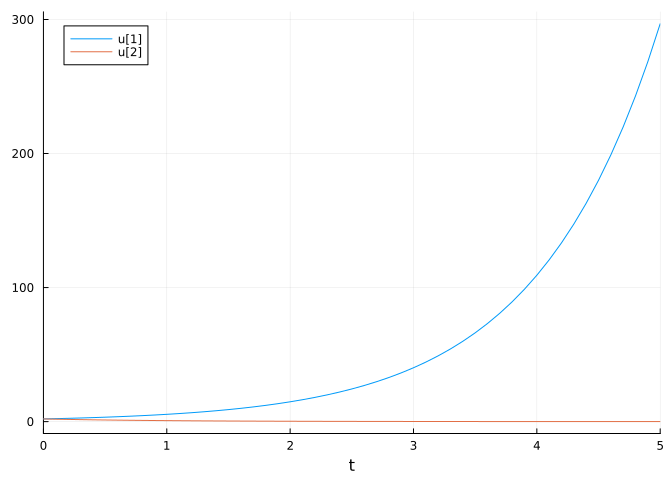
Let’s check our initial model predictions:
prob_nn = ODEProblem(lotka_volterra_nn, u0, tspan, pinit)
init_sol = solve(prob_nn, alg; saveat)
# Plot simulation.
plot(init_sol)
Now we can define our Turing Model. We’ll need to use a utility function
vector_to_parameters that reconstructs the neural network parameter
type based on a sampled parameter vector (taken from this Turing
tutorial). You
do not need to worry about this. Note that we could have used a
component vector, but for some reason this did not work at the time of
the writing of this tutorial…
`vector_to_parameters`
using Functors # for the `fmap`
function vector_to_parameters(ps_new::AbstractVector, ps::NamedTuple)
    @assert length(ps_new) == Lux.parameterlength(ps)
    i = 1
    function get_ps(x)
        z = reshape(view(ps_new, i:(i + length(x) - 1)), size(x))
        i += length(x)
        return z
    end
    return fmap(get_ps, ps)
end
vector_to_parameters (generic function with 1 method)
# Create a regularization term and a Gaussian prior variance term.
sigma = 0.2

@model function fitlv_nn(data, prob)
    # Prior distributions.
    σ ~ InverseGamma(3, 0.5)
    α ~ truncated(Normal(1.5, 0.5); lower=0.5, upper=2.5)
    γ ~ truncated(Normal(3.0, 0.5); lower=1, upper=4)

    nparameters = Lux.parameterlength(nn)
    p_nn_vec ~ MvNormal(zeros(nparameters), sigma^2 * I)

    p_nn = vector_to_parameters(p_nn_vec, p_nn_init)

    # Simulate Lotka-Volterra model.
    p = (;α, γ, p_nn)

    predicted = solve(prob, alg; p, saveat)

    # Observations.
    for i in 1:length(predicted)
        if all(predicted[i] .> 0)
            data[:, i] ~ MvLogNormal(log.(predicted[i]), σ^2 * I)
        end
    end

    return nothing
end


model = fitlv_nn(data_mat, prob_nn)
DynamicPPL.Model{typeof(fitlv_nn), (:data, :prob), (), (), Tuple{Matrix{Float64}, ODEProblem{Vector{Float64}, Tuple{Float64, Float64}, true, ComponentVector{Float64, Vector{Float64}, Tuple{Axis{(σ = 1, α = 2, γ = 3, p_nn = ViewAxis(4:9, Axis(weight = ViewAxis(1:4, ShapedAxis((2, 2))), bias = ViewAxis(5:6, ShapedAxis((2, 1))))))}}}, ODEFunction{true, SciMLBase.AutoSpecialize, typeof(lotka_volterra_nn), UniformScaling{Bool}, Nothing, Nothing, Nothing, Nothing, Nothing, Nothing, Nothing, Nothing, Nothing, Nothing, Nothing, typeof(SciMLBase.DEFAULT_OBSERVED), Nothing, Nothing, Nothing, Nothing}, Base.Pairs{Symbol, Union{}, Tuple{}, @NamedTuple{}}, SciMLBase.StandardODEProblem}}, Tuple{}, DynamicPPL.DefaultContext}(fitlv_nn, (data = [1.8655845948955276 2.298199048573464 … 4.071164055293614 5.672667515002083; 2.651867857608795 3.2812317734519048 … 1.351784872962806 1.1243450946947573], prob = ODEProblem{Vector{Float64}, Tuple{Float64, Float64}, true, ComponentVector{Float64, Vector{Float64}, Tuple{Axis{(σ = 1, α = 2, γ = 3, p_nn = ViewAxis(4:9, Axis(weight = ViewAxis(1:4, ShapedAxis((2, 2))), bias = ViewAxis(5:6, ShapedAxis((2, 1))))))}}}, ODEFunction{true, SciMLBase.AutoSpecialize, typeof(lotka_volterra_nn), UniformScaling{Bool}, Nothing, Nothing, Nothing, Nothing, Nothing, Nothing, Nothing, Nothing, Nothing, Nothing, Nothing, typeof(SciMLBase.DEFAULT_OBSERVED), Nothing, Nothing, Nothing, Nothing}, Base.Pairs{Symbol, Union{}, Tuple{}, @NamedTuple{}}, SciMLBase.StandardODEProblem}(ODEFunction{true, SciMLBase.AutoSpecialize, typeof(lotka_volterra_nn), UniformScaling{Bool}, Nothing, Nothing, Nothing, Nothing, Nothing, Nothing, Nothing, Nothing, Nothing, Nothing, Nothing, typeof(SciMLBase.DEFAULT_OBSERVED), Nothing, Nothing, Nothing, Nothing}(lotka_volterra_nn, UniformScaling{Bool}(true), nothing, nothing, nothing, nothing, nothing, nothing, nothing, nothing, nothing, nothing, nothing, SciMLBase.DEFAULT_OBSERVED, nothing, nothing, nothing, nothing), [2.0, 2.0], (0.0, 5.0), (σ = 0.3, α = 1.0, γ = 1.0, p_nn = (weight = [-1.0083649158477783 -0.7284937500953674; -1.219232201576233 0.4427390396595001], bias = [0.0; 0.0;;])), Base.Pairs{Symbol, Union{}, Tuple{}, @NamedTuple{}}(), SciMLBase.StandardODEProblem())), NamedTuple(), DynamicPPL.DefaultContext())
using Optimization, OptimizationOptimisers
@time map_res = maximum_a_posteriori(model, ADAM(0.05), maxiters=3000, initial_params=pinit)
pmap = ComponentArray(;σ=0, pinit...)
pmap .= map_res.values[:]
sol_map = solve(prob_nn, alg;p=pmap, saveat, tspan = (0, 10))
scatter(tsteps, data_mat',  color = [1 2], label=["Predator abundance data" "Prey abundance data"])
plot!(sol_map, color = [1 2], label=["Inferred predator abundance" "Inferred prey abundance"], yscale=:log10)
12.103192 seconds (31.83 M allocations: 5.634 GiB, 3.78% gc time, 86.93% compilation time: <1% of which was recompilation)
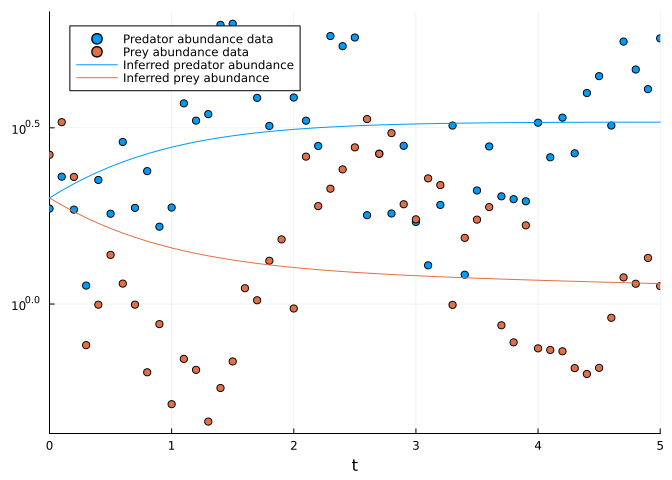
Initial optimization struggles to converge, a common challenge in UDE inference due to the complex loss landscape introduced by neural network parameterization.
Exercise: Improving UDE optimization
What modifications might improve convergence? Consider techniques explored earlier in the tutorial.
Solution
sigma = 0.2
@model function fitlv_nn(data, prob)
    # Prior distributions.
    σ ~ InverseGamma(3, 0.5)
    α ~ truncated(Normal(1.5, 0.5); lower=0.5, upper=2.5)
    γ ~ truncated(Normal(3.0, 0.5); lower=1, upper=4)
    nparameters = Lux.parameterlength(nn)
    p_nn_vec ~ MvNormal(zeros(nparameters), sigma^2 * I)
    p_nn = vector_to_parameters(p_nn_vec, p_nn_init)
    # Simulate Lotka-Volterra model.
    p = (;α, γ, p_nn)
    interval_idxs = multiple_shooting_idx(length(tsteps))
    for ts_idx in interval_idxs
        saveat = tsteps[ts_idx]
        u0 = sol_true.u[ts_idx[1]]
        predicted = solve(prob_nn,
                            alg;
                            tspan = (saveat[1], saveat[end]),
                            u0,
                            p,
                            saveat,
                            abstol=1e-6,
                            reltol = 1e-6)
        # Observations.
        for i in 1:length(predicted)
            if all(predicted[i] .> 0)
                data[:, ts_idx[i]] ~ MvLogNormal(log.(predicted[i]), σ^2 * I)
            end
        end
    end
    return nothing
end
model = fitlv_nn(data_mat, prob_nn)
@time map_res = maximum_a_posteriori(model, Adam(0.1), maxiters=3000, initial_params=pinit)
pmap = ComponentArray(;σ=0, pinit...)
pmap .= map_res.values[:]
sol_map = solve(prob_nn, alg;p=pmap, saveat, tspan = (0, 10))
plot(sol_map, label=["Inferred predator abundance" "Inferred prey abundance"])
scatter!(sol_map.t, data_mat',  color = [1 2], label=["Predator abundance data" "Prey abundance data"], yscale=:log10)
6.436015 seconds (53.74 M allocations: 23.768 GiB, 22.96% gc time, 14.78% compilation time: 75% of which was recompilation)
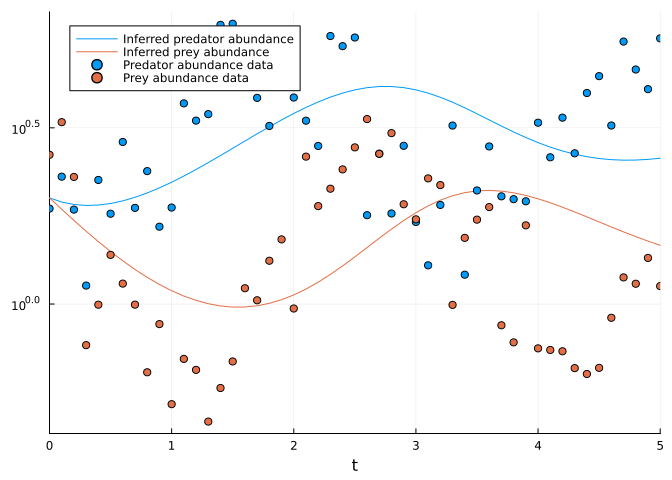
Happy with the convergence? Now let’s investigate what did the neural network learn!
`plot_func_resp`
function plot_func_resp(p, data)
    # plotting prediction of functional response
    u1 = range(minimum(data[1,:]), maximum(data[1,:]), length=100)
    u2 = range(minimum(data[2,:]), maximum(data[2,:]), length=100)
    u = hcat(u1,u2)

    func_resp = nn(u', p.p_nn)

    myplot1 = plot(u2,
                    - p_true.β .* u2;
                    label="True functional form",
                    xlabel="Predator abundance")
    plot!(myplot1,
                u2,
                - func_resp[1,:];
                color="#BBBBBB",
                label="Inferred functional form")

    myplot2 = plot(u1,
                    p_true.δ .* u2;
                    legend=false, xlabel="Prey abundance")

    plot!(myplot2,
            u1,
            func_resp[2,:];
            color="#BBBBBB")

    myplot = plot(myplot1, myplot2)
    return myplot
end
plot_func_resp (generic function with 1 method)
plot_func_resp(pmap, data_mat)
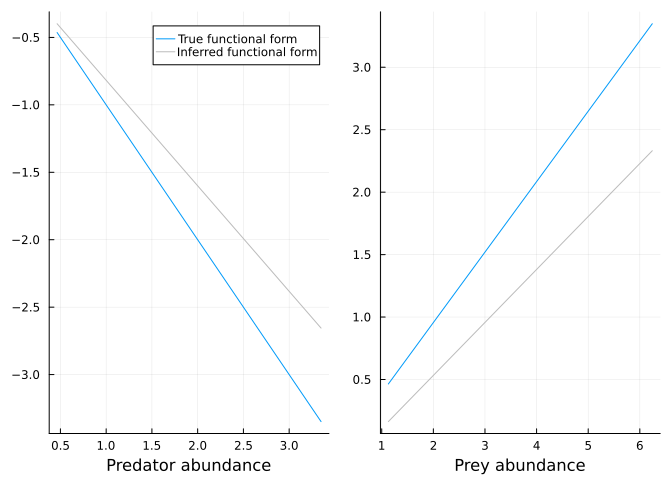
The neural network successfully recovers the true linear functional responses, demonstrating that UDEs can discover mechanistic relationships directly from data.
Exercise: Probabilistic functional forms
Could you try to obtain a bayesian estimate of the functional forms with e.g. VI?
This concludes the tutorial. The methods presented—from gradient-based optimization through Bayesian inference to universal differential equations—provide a comprehensive framework for mechanistic inference in computational science. These techniques are readily applicable to a wide range of scientific domains where interpretability and mechanistic understanding are paramount.
Resources